
4. August 2026

The money arrives in 2028. The sentence that unlocks it is being written this year.

The funding map under every German project has an expiry date >> December 2027. Every EU regional programme now open, and every co-financing rate sitting in today’s financial models, ends with the current budget period.

What comes next was proposed in July 2025, almost €2 trillion for the 7 years from 2028, the largest budget the European Union has ever put on the table.¹ Nobody disputes the size of the money. What it will actually pay for is another matter, because that list is still being written, in Brussels, in Berlin, in the regional capitals, by people working to deadlines that fall this year and next.

From close to 540 documents to 28 plans

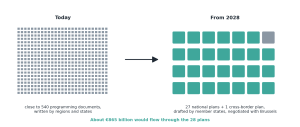
Today, EU regional money reaches a German project through a programme written by the region itself. Lower Saxony writes its own, Bavaria writes its own, and so on across Europe, close to 540 programming documents in all. The Commission proposes to replace them with 28. One National and Regional Partnership Plan per member state, and 1 more for cross-border work.² About €865 billion would flow through these plans, roughly €450 billion of it for regional development, rural areas and fishing communities.³

The proposed rewrite of how EU money is planned. Sources 2 and 3.


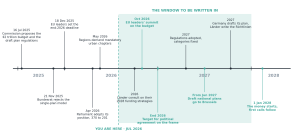
The first document that decides whether your kind of project is fundable would no longer be written in your regional capital. It would be written in Berlin, or Paris, or Warsaw, and negotiated with Brussels. And the German states did object. In November 2025 the Bundesrat rejected the single-plan model outright and asked for regional funding to stay where it is, with the Länder and their administrations.⁴ That issue is not settled, however the clock is ticking towards 2028. Whichever level ends up holding the pen, the plans get drafted during 2027, drafts can go to Brussels from June, and the money starts on 1 January 2028.⁵

What changes for a project owner

Today, 2021 to 2027 From 2028, as drafted
Who writes the plan your project must fit Your region or Land, one of close to 540 documents Your national government, one of 28 plans²
Urban money 8% of regional development money reserved for sustainable urban development No reservation. Urban chapters optional⁶
Housing Not a named objective A specific objective, inside a 14% social spending minimum⁷
Regional money guaranteed for regions €376 billion across the Union Between €228 billion and €463 billion, depending on national choices not yet made⁸
Where your project needs to be described The regional programme The national plan, fed by the regional strategies being written now


What the draft warms to, and what it leaves open

Parts of the draft are friendlier to urban projects than anything before it. Affordable and social housing is named as a specific objective of the national plans for the first time.⁷ In December 2025 the Commission adopted a European Affordable Housing Plan, with a housing construction strategy and revised state aid rules beside it, and a European Affordable Housing Act was consulted in spring 2026 with the legal proposal still to come.⁹ A project with serious housing numbers has more to point at than it has ever had.

Other parts are quieter. The 8% urban reservation disappears. Integrated urban development survives as a tool a country may use, but whether a national plan contains an urban chapter at all is left open rather than required.⁶ And the draft regulation does not once use the words brownfield or land recycling, although turning disused industrial land into living districts is one of the few moves that serves housing, climate and land-saving at the same time.

Nothing in the draft prevents money for urban transformation after 2027. Nothing guarantees it. This autumn decides which of those sentences ends up mattering.

Why this year, and not next

The reason to move in 2026 rather than 2027 is the way the layers lock, each one setting the menu for the one below it.

  1. The top layer is the European regulations, in open negotiation this autumn. In April 2026 the Parliament adopted its position by 370 votes to 201 and wants the single-plan model changed.¹⁰ The Committee of the Regions asked in May for territorial chapters to be made mandatory.¹¹ City networks want urban shares written into the text, at least 15% of each plan in one demand, 30% for integrated territorial development in another.¹² The governments took their first partial positions in June. They aim to agree the whole frame by the end of the year, with a leaders’ summit in October on the way.¹³ Whatever categories these texts recognise when they close is all any plan below them can contain.
  2. Below that sits Germany’s plan, drafted during 2027.⁵ A category the regulation allows but the plan never names is, for a German project, a category that does not exist.
  3. Then the Länder, and every one of them is already moving. Baden-Württemberg went to Brussels early, a paper handed to the Commission in February 2024, a cabinet position adopted in Brussels a year later. Lower Saxony has been building its funding strategy for 2028 to 2034 since summer 2025, 5 workshops, more than 200 people from business, municipalities, science and the social sector, a workshop report in March 2026. Bavaria’s programme authorities have joined the other Länder in defending regional delivery of the funds.¹⁴ From 2027 all of this hardens into the Richtlinien a project actually applies against. By the time the first calls open in 2028, the menu is printed.

Read upward, the same cascade is good news. A sentence placed in the right document this year travels down through every layer that follows it. That is what acting now buys, nothing about 2028 requires a project to be finished, financed or approved this year. It requires the project to be described.

The road to 2028. Shaded, the period in which the documents are still open. Sources 1, 4, 5, 10 to 14.


The instruments, by name

A phrase like “the proposal” hides a set of specific legal texts and programmes, each with its own state of play. These are the ones that matter for anyone holding a site.

Instrument What it is Where it stands, July 2026
The MFF regulation The €2 trillion frame for 2028 to 2034 In the Council’s negotiating box, political agreement targeted for the end of 2026¹³
The partnership plans regulation, COM(2025) 565 Creates the 28 national plans carrying about €865 billion, absorbing the regional funds, the social fund, agriculture and fisheries Parliament committee stage, amendments through autumn and winter¹⁰
The ERDF and Cohesion Fund regulation, COM(2025) 552 Keeps the regional funds as named instruments inside the plans Early committee stage
The ESF regulation, COM(2025) 558 The social fund inside the plans, with the 14% social minimum⁷ Early committee stage
The European Competitiveness Fund €234 billion outside the plans, for industry, clean technology, health, bioeconomy and digital¹⁵ Council partial position, June 2026¹³
The EU Facility and the cities line Direct EU money beside the plans, including a single €11 billion line for cities, social innovation and employment⁶ In negotiation with the rest of the package
The European Affordable Housing Plan and the Affordable Housing Act The housing push. The Plan was adopted in December 2025, the Act was consulted in spring 2026⁹ Act proposal awaited
Germany’s National and Regional Partnership Plan The one document that would decide what German projects can ask for Drafted during 2027, with the Länder⁵
The Landesförderstrategien of the Länder Each Land’s strategy for the period, which hardens into the Richtlinien projects apply against In preparation across the Länder, from Stuttgart to Hannover to Munich¹⁴


One more number belongs in every financial model now rather than in 2028. Independent analysis puts the regional money guaranteed under the proposal anywhere between €228 billion and €463 billion across the Union, depending on choices national governments have not yet made. The current period carries €376 billion.⁸ Nobody can tell a project today what its co-financing rate will be in 2029 >> nobody. So the private side of the funding, the banks, the guarantees, the owner’s own money, has to carry more and has to be designed earlier. Blended finance, the subject of the last piece in this blog series, stops being good practice and becomes essential.

The 2028 check

Every project with a horizon past 2027 should be able to answer what follows.

Where is your project described? In which strategy, programme or plan feeding the 2028 documents does your project, or its category, appear in writing, and who wrote the sentence?
What co-financing rate does your financial model assume? And what happens to the plan if the EU pays a smaller share after 2027 than it pays today?
Who carries the growing private share? Are the banks, the guarantees and the owner’s own money designed to carry more from 2028 than they carry today?


If any answer is missing, do not wait for 2028. Contact us at steg PS. We can start right now, and this is what starting looks like.

1 The 2028 check. In one working session we go through your project’s financing assumptions against the new period and tell you where it is exposed.
2 Getting you described. We draft the submission that puts your project, or its category, into the consultations and strategies feeding the 2027 drafting. This autumn’s consultations are the last that feed it, and we know which doors are open.
3 The funding stack. We design the mix of grants, loans, guarantees and your own capital so the model still works when the EU share is smaller.


The projects that receive European money in 2029 will be the ones already described in documents written in 2026 and 2027. That is not cynicism, it is how programming works. A conversation costs an afternoon. A missed period costs most of a decade. Where will your project be written down, and who is holding the pen? If you would rather not find out in 2028, contact us before the texts close.

Written by: Alyssa Jade McDonald-Baertl, Martin Lepper, Nils T. Kohle

——————————————————

A short glossary of terms

Multiannual Financial Framework (MFF)  The EU’s 7-year budget plan. The next one runs from 2028 to 2034.

National and Regional Partnership Plan  The proposed single plan per member state through which most EU regional, social, agricultural and fisheries money would flow from 2028.

Cohesion policy  The EU’s policy for reducing economic gaps between regions, today delivered through regional programmes.

Programming document  A plan agreed between a region or country and the Commission that sets what EU money there may pay for. Being described in one is what fundable means.

Earmark, or reservation  A rule that a fixed share of a fund must be spent on a named purpose.

Co-financing rate  The share of a project’s cost the EU pays. The rest is found nationally, regionally or privately.

Integrated urban development  Funding a district as one whole, housing, mobility, public space and economy together, rather than as separate projects.

Territorial chapter  A section of a national plan dedicated to the needs of a region or city. Optional in the current draft.

Brownfield  Land that was previously built on or used industrially and now lies unused.

Richtlinie  A German funding guideline, the document a project actually applies against.

Negotiating box  The Council’s working draft of the budget deal, updated by each presidency.

Partnership principle  The EU rule that plans must be prepared together with regions, cities and civil society, not by national governments alone.

Blended finance  Paying for one project out of several different pots at once, usually mixing public grants, loans and private money.

THE INSTITUTIONS

European Commission  The EU’s executive. Proposes the budget and the rules that govern it. ec.europa.eu

Council of the European Union and the European Council  The governments of the 27 member states, who must agree the budget unanimously. consilium.europa.eu

European Parliament  Must consent to the budget and amends the fund regulations. europarl.europa.eu

European Committee of the Regions  The EU body where regions and cities have a formal voice. cor.europa.eu

Bundesrat  The German chamber through which the 16 Länder governments act at federal level. bundesrat.de

Eurocities  The network of major European cities. Source of the 15% urban demand. eurocities.eu

CEMR  The Council of European Municipalities and Regions, referred to in this piece as the European association of municipalities. Source of the 30% demand. ccre-cemr.org

THE FUNDS

EU regional funds (ERDF and the Cohesion Fund)  Today’s main funds for regional development and infrastructure, which the new plans would absorb.

ESF+  The EU fund for skills, training and employment, likewise absorbed into the plans.

European Competitiveness Fund  A proposed €234 billion fund for industry, clean technology, health, bioeconomy and defence, sitting outside the national plans.

EU Facility  The part of the plans fund kept back for direct EU actions, including the €11 billion cities line.

Interreg  EU funding for projects that work across national borders. The 28th plan.

Sources

  1. European Commission, proposal for the Multiannual Financial Framework 2028 to 2034, presented 16 July 2025, almost €2 trillion in current prices. commission.europa.eu/strategy-and-policy/eu-budget/long-term-eu-budget/eu-budget-2028-2034_en
  2. European Commission, questions and answers on the 2028 to 2034 budget, 16 July 2025. Close to 540 programming documents replaced by 27 National and Regional Partnership Plans plus 1 Interreg plan. ec.europa.eu/commission/presscorner, QANDA/25/1848
  3. European Commission, DG Regional and Urban Policy, 17 July 2025. About €865 billion in total financing through the plans, around €450 billion dedicated to cohesion, rural development and fishing communities, current prices. ec.europa.eu/regional_policy
  4. Bundesrat, resolutions of 21 November 2025 on the budget package, including Drucksache 460/25 on the partnership plans regulation. bundesrat.de
  5. COM(2025) 565 final, 16 July 2025, the draft regulation for the plans. Draft plans may be submitted from June 2027, with formal submission around the start of 2028. The precise deadline sits in the recitals of the draft and may move in negotiation.
  6. ESPON policy brief on the urban dimension of cohesion policy, January 2026, on the 8% earmark in the 2021 to 2027 rules. European Parliamentary Research Service briefing 777938, 2025, on the absence of a binding urban measure in the proposal and the single €11 billion cities line.
  7. COM(2025) 565 final, recitals 15 and 17, affordable and social housing as a specific objective. The 14% minimum for social expenditure per European Parliament budget committee briefing BUDG_BRI(2026)783552, January 2026.
  8. Bruegel, National plans, regional voices, cohesion policy in the next EU budget, policy brief, 26 March 2026. Guaranteed cohesion funding of €228.1 to €463.2 billion depending on member-state choices, against €375.9 billion in 2021 to 2027. An independent analysis, not an official figure. bruegel.org
  9. European Commission, European Affordable Housing Plan, COM(2025) 1025, adopted 16 December 2025, including a European Strategy for Housing Construction and revised state aid rules. Consultation on the Affordable Housing Act opened 6 March 2026, call for evidence closed 3 April 2026, proposal pending. housing.ec.europa.eu
  10. European Parliament, interim report A10-0105/2026, rapporteurs Mureșan and Tavares, adopted April 2026 by 370 votes to 201 with 84 abstentions. EPRS summary, 6 May 2026. Committee work on the sectoral regulations continues through the second half of 2026.
  11. European Committee of the Regions, opinions adopted at the 171st plenary, 6 and 7 May 2026, including CDR 3467/2025 on the plans regulation, rapporteurs Boc and Cordeiro.
  12. Eurocities reaction to the proposal, 17 July 2025, at least 15% of the plans for urban priorities. CEMR, 40 amendments to the plans and ERDF regulations, 14 January 2026, 30% for integrated territorial development.
  13. Council of the EU, official timeline of the 2028 to 2034 negotiations. The European Council of 18 December 2025 called for agreement by the end of 2026. General Affairs Council of 16 June 2026, partial negotiating positions including on the plans and the Competitiveness Fund. The Irish presidency works toward the October 2026 European Council. consilium.europa.eu
  14. Baden-Württemberg, position paper on cohesion policy from 2028 handed to the Commission on 19 February 2024, and cabinet position adopted in Brussels in February 2025, efre-bw.de. Land Niedersachsen, EU-Landesförderstrategie 2028 to 2034, launch 18 August 2025, 5 workshops with over 200 participants, workshop report presented 19 March 2026, europa-fuer-niedersachsen.niedersachsen.de. Bavaria, EFRE Bayern on the joint positioning of the Länder programme authorities, efre-bayern.de
  15. European Commission, DG Internal Market, Industry, Entrepreneurship and SMEs, the European Competitiveness Fund, €234 billion across 4 windows including bioeconomy, proposed 16 July 2025. single-market-economy.ec.europa.eu

Weitere Beiträge

4. August 2026

Turning old sites into something new, and how it gets paid for by European Funds

Europe is putting a lot of money into old industrial sites this year. In June 2026 the European Investment Bank put another €22 billion behind InvestEU, a scheme that uses...

A future resilient quarter in a German city comprising of older and newer buildings
4. August 2026

The money arrives in 2028. The sentence that unlocks it is being written this year.

The funding map under every German project has an expiry date >> December 2027. Every EU regional programme now open, and every co-financing rate sitting in today’s financial models, ends...

3. August 2026

Resilienz wird gebaut: Warum die neue CER-Richtlinie Bauwirtschaft, Infrastruktur und Quartiere zur Führungsaufgabe macht

Seit den Sabotageakten gegen kritische Infrastruktur der vergangenen Jahre ist klar: Sicherheit lässt sich nicht mehr allein als IT-Thema behandeln. Mit der europäischen CER-Richtlinie (Critical Entities Resilience) und dem deutschen...

Informationen für Unternehmen: